

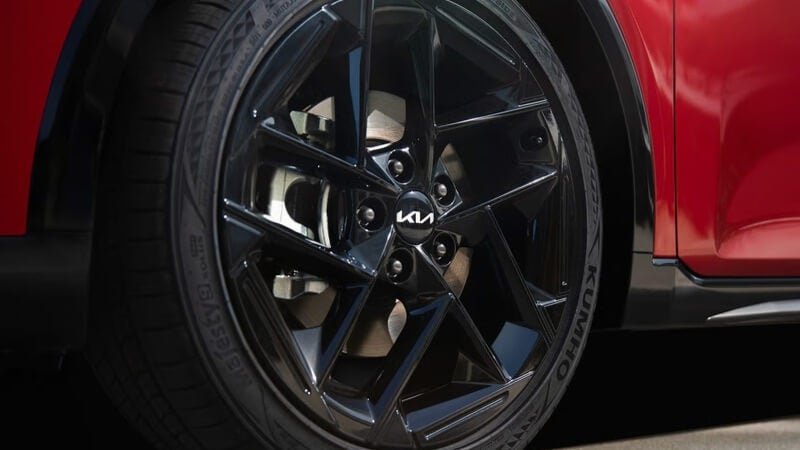
Tires wear down unevenly primarily due to wheel misalignment, incorrect tire inflation pressure, worn steering or suspension parts, and skipping scheduled tire rotations. When suspension angles shift out of factory specification, the tire contacts the pavement at an improper angle, scrubbing rubber rapidly off one edge. Underinflated tires wear heavily on both outer shoulders, while overinflation strips the center tread. Routine impacts with potholes or curbs accelerate this wear by knocking steering linkages out of true.
Every time a tire rolls along the pavement, its entire contact patch should distribute the vehicle's weight uniformly across the tread surface. In family vehicles like the Kia Sorento, which carries seven passengers and handles daily family transport, even minor geometry shifts cause the tires to fight against the direction of travel rather than rolling freely. When wheels are angled inward or outward, or tilted along their vertical axis, friction concentrates on a narrow band of tread. This concentrated friction shaves off rubber miles ahead of schedule and reduces your vehicle's overall fuel efficiency.
Tire wear also accelerates when front and rear axles perform different mechanical jobs. On front-wheel-drive crossovers, the front tires absorb the combined forces of steering, engine torque delivery, and roughly 70 percent of braking friction. If you skip scheduled tire rotations, those front tires develop severe outer shoulder wear while the rear tires remain relatively smooth. Regular rotations balance out these distinct axle stresses before permanent wear patterns set in.
When you notice your vehicle drifting on flat asphalt, you can reach out to our service advisors with a quick call to discuss an inspection. For drivers traveling along coastal highways near the Pithlachascotee River, our service center location provides factory-calibrated alignment racks designed to restore correct angles. Correcting these mechanical factors early protects your tire investment and maintains predictable emergency handling.
How Incorrect Tire Pressure and Suspension Angles Cause Abnormal Tread Patterns
Specific tread wear patterns point directly to their mechanical root causes, with tire inflation affecting lateral wear across the contact patch and suspension angles dictating edge-specific scrubbing. Measuring tread depth across the inner shoulder, center groove, and outer shoulder reveals whether air pressure, wheel angles, or failing mechanical parts caused the degradation.
Underinflation causes both outer tread edges to carry the vehicle's load while the center contact patch buckles slightly upward. This concave contact shape grinds down both shoulders simultaneously while leaving ample rubber down the middle. In hot coastal climates with sustained high ambient temperatures, running underinflated tires causes excessive sidewall flexing that generates dangerous internal heat. Conversely, overinflation balloons the center of the tire outward. The center tread carries nearly all the vehicle weight, creating a distinct bald strip down the center while the outer edges show minimal wear.
Suspension geometry misalignments generate entirely different wear signatures across the tread block:
- Camber Wear (Single-Edge Wear): Occurs when the wheel tilts inward or outward at the top. Negative camber tilts the top of the tire inward toward the chassis, grinding away the inner edge of the tread. Positive camber tilts the top outward, stripping the outer shoulder.
- Toe Wear (Feathering): Develops when tires point inward toward each other like pigeon toes (toe-in) or outward away from the vehicle centerline (toe-out). Toe misalignment scrubs the tread sideways across the road surface, producing fine, saw-toothed feathered edges that you can feel when running your hand across the tread.
- Cupping and Scalloping: Appears as random dips, hollows, or wavy patches around the tread circumference. This pattern signals worn shock absorbers, degraded struts, or loose suspension bushings that allow the wheel to bounce uncontrolled against the pavement.
When suspension joints loosen or rubber bushings split, the wheel assembly cannot hold its alignment angles under braking or cornering loads. If your vehicle requires replacement tie rod ends, control arms, or factory hardware, you can order genuine components through our dealership parts department to ensure exact factory fitment and durability.
Wheel Alignment vs. Wheel Balancing: How Do Mechanical Differences and Symptoms Differ?
Wheel alignment adjusts the physical angles of your vehicle's steering and suspension components, whereas wheel balancing corrects heavy spots around the individual tire and rim assembly. Although drivers frequently confuse the two procedures, they address completely different mechanical systems and produce distinctly different warning symptoms on the road.
An alignment procedure places the vehicle on an optical or laser alignment rack. Technicians adjust tie rods, control arm eccentric bolts, and strut mounts to ensure the wheels are parallel to each other and perpendicular to the road surface according to factory specifications. Alignment does not involve adding or removing weight from the wheels. In contrast, wheel balancing places the dismounted tire and rim assembly onto a high-speed dynamic spin balancer. The machine detects tiny weight discrepancies around the circumference, prompting the technician to attach small counterweights along the wheel barrel to neutralize centrifugal imbalances.
The symptoms behind these mechanical issues differ noticeably during routine driving:
- Alignment Fault Symptoms: The primary telltale sign is a persistent steering pull or drift toward one side of a flat road. The steering wheel often sits visibly crooked while you are driving straight ahead, and tires develop smooth, one-sided shoulder wear or feathered edges. Alignment issues rarely generate physical vibrations through the steering wheel.
- Wheel Imbalance Symptoms: The defining symptom is a rhythmic vibration or shaking that begins around 50 to 55 mph and intensifies as vehicle speed climbs. An unbalanced front tire transmits rapid vibrations directly into the steering wheel rim, whereas an unbalanced rear tire creates a seat or floorboard buzz. Imbalance causes localized bald spots or scalloped patches around the circumference rather than continuous edge-to-edge scrubbing.
Balancing and alignment do not mechanically depend on one another, meaning an aligned vehicle can still suffer from out-of-balance vibrations. However, performing both services together when mounting fresh rubber or addressing suspension wear ensures smooth, vibration-free travel alongside maximum tread longevity.
What Are the Immediate Warning Signs That Your Vehicle Needs an Alignment?
Immediate warning signs of severe wheel misalignment include active pulling to one side, a crooked steering wheel spoke on straight roads, loose steering response, and squealing tires during gentle low-speed turns. Recognizing these operational cues early prevents a minor suspension adjustment from turning into the premature replacement of an entire set of tires.
A classic early warning sign is tracking deviation. On a level, smooth roadway with no crown, releasing light pressure from the steering wheel should allow your vehicle to continue tracking straight forward. If the car immediately drifts, dives, or jerks toward the ditch or oncoming traffic lane, suspension geometry has drifted out of tolerance. An off-center steering wheel is an equally clear indicator. When the vehicle tracks in a straight line, the horizontal steering wheel spokes should sit completely level; if the wheel must be held at an angle to maintain a straight path, the tie-rod angles are uneven.
Tire noise also alerts drivers to alignment trouble. When toe angles are incorrect, the tires continuously scrub laterally against the asphalt surface rather than rolling straight. This lateral friction causes tires to chirp or squeal when turning into parking spaces or navigating gentle neighborhood curves at low speeds. Commuters using the Suncoast Parkway from residential areas like Trinity frequently notice that misaligned vehicles feel wander-prone at highway speeds, requiring constant minor steering corrections to stay centered within lane boundaries.
Severe pothole strikes, running over construction debris, or striking a concrete parking curb can knock steering knuckles or tie rods out of place instantly. If a hard impact changes the centering of your steering wheel or causes an abrupt drift, scheduling an immediate alignment check prevents rapid tire scrubbing before irreversible tread damage develops.
When Should You Get an Alignment, and Do New Tires Require One?
You should get a wheel alignment every 12 months or roughly every 10,000 to 12,000 miles, as well as immediately following any suspension part replacement, severe road impact, or fresh tire installation. While mounting new tires does not mechanically force suspension angles to change, pairing new rubber with an alignment check is standard maintenance practice to prevent pre-existing geometry errors from ruining your investment.
Installing brand-new tires on an improperly aligned vehicle begins shaving rubber off the fresh tread blocks on the very first drive. Many drivers replace tires because the old set wore thin on the shoulders, failing to realize that an uncorrected alignment issue caused that wear in the first place. Putting fresh rubber onto misaligned suspension components subjects the new tires to the exact same abrasive forces. Having technicians verify camber, caster, and toe specifications protects your tire purchase from premature structural wear.
Key intervals and conditions that call for an immediate alignment check include:
- Annual Maintenance: Having alignment angles verified once a year or every other oil change catches gradual settling from normal spring and bushing wear.
- Suspension and Steering Component Replacement: Installing new ball joints, tie rods, control arms, struts, or steering racks directly alters linkage lengths, making an immediate four-wheel alignment mandatory.
- Following Significant Impacts: Smacking deep potholes, scraping high curbs, or bouncing across debris jars suspension mounting points and bends adjustment sleeves.
- When Handling Characteristics Change: Any unexplained vehicle pulling, steering wheel off-center tilt, or low-speed tire squeal demands prompt diagnosis.
Modern safety systems also make proper alignment essential. Driver-assist technologies such as lane assist and forward collision systems rely on precise steering angle sensors calibrated directly to the mechanical center of the steering rack. An accurate four-wheel alignment ensures that your vehicle's physical trajectory perfectly matches the data read by onboard electronic sensors.
Tire Wear and Alignment Service: Answers to Common Questions
Q: Can an alignment fix uneven tire wear that has already occurred?
An alignment corrects the suspension geometry to stop active scrubbing, but it cannot restore rubber that has already worn off your tire. Once a tire develops severe heel-toe feathering or a bald inner shoulder, that irregular profile remains permanently cut into the tread block. The goal of performing the alignment is to prevent that wear pattern from spreading deeper across the rest of the tire surface. In severe cases where cords or steel belts are visible along a stripped shoulder, the tire must be replaced immediately for safety.
Q: Why does my vehicle still pull to one side after a fresh alignment?
A vehicle that continues to drift after alignment usually suffers from radial tire pull, road crown slope, or an uneven tire inflation level. Radial pull happens when uneven internal tire wear or a shifted internal belt causes one tire to roll with higher rolling resistance than its counterpart. Technicians often diagnose this by crossing the front tires side to side; if the direction of the pull reverses, the tire construction or wear pattern is responsible rather than the chassis geometry. Sticking brake calipers can also drag a vehicle toward one side.
Q: How long does a standard four-wheel alignment service take?
A standard computerized four-wheel alignment typically takes about an hour to perform under normal shop conditions. The procedure involves mounting specialized electronic targets to all four wheels, rolling the vehicle to capture baseline sensor readings, and systematically adjusting tie rods, steering sleeves, and suspension cams to factory specifications. If technicians encounter rusted adjustment sleeves that require penetrating heat, or discover worn ball joints and tie rods that must be replaced before angles will hold, the overall service time extends accordingly.
Q: Will skipping wheel alignments void any part of my vehicle warranty?
Skipping routine alignments will void your tire manufacturer's treadwear mileage warranty, as tire brands universally exclude damage resulting from mechanical misalignment, improper inflation, or neglected rotations. Mechanical coverage under Kia’s 10-year/100,000-mile warranty remains focused on manufacturer defects in powertrain parts rather than routine wear items like tires or maintenance adjustments. However, letting severe misalignment go unchecked places intense, unnecessary vibration and stress on wheel bearings, steering racks, and suspension joints over thousands of miles.
Q: What should I check between service visits to protect my tread life?
Check your tire pressures at least once a month when the rubber is completely cold, using a reliable digital tire pressure gauge. Confirm that your readings match the manufacturer specification listed on the driver's door jamb sticker rather than the maximum pressure stamped onto the tire sidewall. Take a few moments to inspect the inner and outer shoulders of all four tires under bright light, feeling along the tread face for any rough, saw-toothed feathering or bald spots.
To maintain your vehicle's steering precision and protect tread life, you can schedule a service appointment with our factory-trained maintenance team.
Protecting Your Tires and Suspension Health
Catching alignment drift and uneven tread wear early saves families from expensive premature tire replacements and keeps daily travel predictable. If you hit road debris or notice an off-center steering wheel, give our certified service department a direct call to review your vehicle's symptoms. If you ever experience unexpected tire deflation or wheel damage while traveling, manufacturer-backed Kia Roadside Assistance: 1-800-333-4KIA offers authorized emergency dispatch and towing support directly to certified service centers. Drivers can drop by our New Port Richey service facility at 5819 US Highway 19 for a comprehensive computerized alignment check, tire inspection, and precision suspension adjustment.
Prices and MSRP referenced in this article are estimates for informational purposes only and do not constitute an offer to sell. See dealer for complete details. Fuel economy estimates shown may differ from official EPA ratings and should not be relied upon as a guarantee of actual vehicle performance.



 Warranties include 10-year/100,000-mile powertrain and 5-year/60,000-mile basic. All warranties and roadside assistance are limited. See retailer for warranty details.