
Today: 9:00AM - 8:00PM
Blog

Exploring Starkey Wilderness Park in a Kia Telluride

Outdoor enthusiasts planning trips to local trailheads need a vehicle that balances everyday driving comfort with genuine utility. The Kia Telluride earns top safety marks, including an IIHS Top Safety Pick+ award and a 5-Star Overall Safety Rating from the NHTSA, providing structural confidence when traveling on high-speed highways and isolated rural routes.

Yes, the 2027 Kia Telluride is thoroughly engineered for wilderness road trips, combining a 3.8-liter V6 engine producing 291 hp, available active all-wheel drive, and up to 5,500 pounds of maximum towing capacity. With over 8 inches of ground clearance and roughly 87 cubic feet of total cargo space, it easily navigates unpaved park roads, heavy camping equipment, and long family drives across Florida.

Under the hood, the standard naturally aspirated V6 delivers 262 lb-ft of torque through an 8-speed automatic transmission. This powertrain offers steady, linear acceleration when merging onto busy corridors or maintaining speed with a loaded cabin. When paired with Kia's active on-demand all-wheel-drive system, power shifts automatically between the front and rear wheels to maintain traction on wet asphalt, loose sand, or gravel paths.

For drivers heading out from New Port Richey, accessing nearby outdoor destinations like Starkey Wilderness Park requires navigating a mix of suburban streets, highway stretches, and winding park roads. The Telluride handles these transitions without compromising interior quietness or ride smoothness. To explore available models in person or map your drive to our dealership, check our showroom on US Highway 19 or give our sales team a call at (888) 604-4352.

How Does the Kia Telluride Perform on Dirt Roads and Mild Off-Road Trails at Starkey Wilderness Park?

The 2027 Kia Telluride handles dirt roads and mild off-road trails with ease, utilizing its active all-wheel-drive system, specialized Terrain Mode settings, and up to 9 inches of ground clearance on rugged trims. Its calibrated suspension absorbs ruts and washboard surfaces, keeping the cabin stable for all passengers.

Exploring unpaved park routes means encountering soft sand, loose gravel, and mud after heavy Florida rainfall. Standard Telluride models provide over 8 inches of ground clearance, which easily clears small rocks, tree roots, and shallow dips. For drivers seeking greater trail capability, the X-Line package and X-Pro package elevate ground clearance to 9 inches, improving approach and departure angles for uneven terrain.

The X-Pro trim enhances off-pavement performance by adding an Electronic Limited-Slip Differential, 18-inch wheels wrapped in all-terrain tires, and heavy-duty engine cooling. When driving through loose dirt or slick clay, the all-wheel-drive system can lock power 50/50 between the front and rear axles at low speeds. Drivers can select specialized terrain modes to recalibrate throttle sensitivity and traction control for maximum grip.

Families comparing trims on our showroom floor often ask whether the extra ground clearance on rugged trims is necessary for local park trails before they test the fold sequence on the second-row seats. While base front-wheel-drive configurations handle paved main roads without issue, opting for all-wheel drive or browsing our pre-owned SUV inventory for all-terrain capability gives drivers extra peace of mind when venturing off the main path.

Can the 2027 Kia Telluride Tow a Camper to Starkey Wilderness Park?

The 2027 Kia Telluride comfortably tows a camper to Starkey Wilderness Park with a standard tow rating of 5,000 pounds that increases to 5,500 pounds on X-Line and X-Pro models equipped with the factory tow package. This capacity allows families to pull single-axle travel trailers, pop-up campers, utility trailers, or double personal watercraft without straining the engine.

Hauling heavy loads across Florida highways requires proper weight management and electronic driver support. The Telluride features standard Trailer Stability Assist, which works alongside the vehicle's electronic stability control to detect trailer sway. If crosswinds or sudden lane adjustments cause oscillation, the system selectively applies individual brakes and reduces engine torque to stabilize the trailer.

To assist with heavy tongue weights, select Telluride trims offer an available self-leveling rear suspension. This system automatically adjusts the rear ride height when a heavy trailer is attached, preventing rear-end sag, maintaining proper headlight alignment, and ensuring firm front-tire contact for precise steering control.

Key factory towing features on the Kia Telluride include:

  • Integrated Class III receiver hitch and 7-pin wiring harness
  • Heavy-duty engine cooling fan and transmission fluid cooler
  • Dedicated Tow Mode shift mapping to prevent gear hunting on inclines
  • High-resolution backup camera with dynamic hitch guidelines for quick alignment

What Cargo Capacity and Family Comfort Features Does the Kia Telluride Offer for Camping Trips?

With up to 87 cubic feet of maximum cargo capacity and standard three-row seating for up to eight passengers, the 2027 Kia Telluride provides versatile interior utility for family camping trips. The cabin easily accommodates tents, coolers, sleeping bags, and bulky gear bags alongside a full crew of campers.

Behind the third row, the Telluride offers 21 cubic feet of storage space, which is enough room for several duffel bags and daypacks. When extra gear space is required, the 60/40 split-folding third-row seats tumble flat with a single pull, expanding cargo volume to 46 cubic feet. Folding both rear rows opens up the full 87 cubic feet of flat floor space. Heavy-duty roof rails come standard on most trims, allowing drivers to mount cargo boxes, kayak racks, or bike carriers.

Passenger comfort remains a priority during long drives out to outdoor parks. Available second-row captain's chairs slide forward with a single touch, clearing a wide walkway to the third row even with a child seat installed. High-trim models feature heated and ventilated seats in both the first and second rows, tri-zone automatic climate control with ceiling-mounted vents, and premium seating upholstery designed for easy cleaning after a day on the trail.

For active households around Trinity, loading up soccer gear during the week and packing camping equipment on the weekend demands a flexible interior layout. The Telluride delivers that versatility while maintaining a refined, quiet cabin environment on every trip.

Which Tech Features Help the 2027 Kia Telluride on Long Trips to Wilderness Parks?

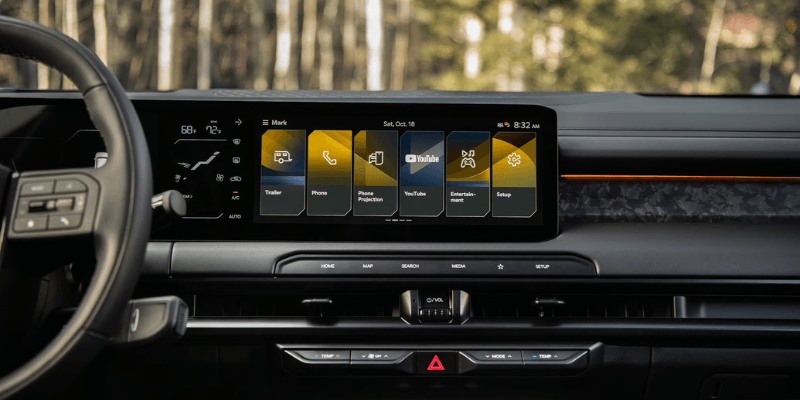
The 2027 Kia Telluride delivers essential long-trip technology, including dual 12.3-inch panoramic displays, standard wireless Apple CarPlay and Android Auto, and the Drive Wise driver-assist suite. These features keep drivers informed and passengers entertained during extended road trips.

Navigation and media are managed through the central 12.3-inch touchscreen, which seamlessly integrates with an available matching 12.3-inch digital instrument cluster. Drivers can view real-time maps, route weather, and media controls side-by-side. Dual wireless phone charging pads in the front console keep devices powered up without cluttering the cabin with cords, while USB-C charging ports are distributed across all three rows so every passenger can charge a device.

Highway driving is supported by Kia's advanced driver-assist systems. Navigation-Based Smart Cruise Control automatically adjusts vehicle speed based on upcoming highway curves, while lane assist and blind spot detection monitor surrounding traffic. Features like Forward Collision-Avoidance Assist provide active braking intervention if a potential front-end hazard is detected.

On remote drives near state parks, the available Ground View Monitor provides a camera-based display of the terrain directly beneath the front bumper at low speeds, helping drivers steer clear of high rocks, stumps, or deep ruts when maneuvering through tight campsites.

Questions Buyers Ask About Exploring with the 2027 Kia Telluride

Q: Is the Kia Telluride good for driving on dirt roads and unpaved park paths?

Many buyers ask if the Telluride can handle unpaved paths; its active AWD and Terrain Modes make it a reliable choice. With over 8 inches of standard ground clearance, available active all-wheel drive, and specialized terrain modes, it easily navigates rutted dirt, packed gravel, and sand. The X-Pro trim adds 9 inches of ground clearance and all-terrain tires for added traction on unpaved trails.

Q: How much cargo space is available in the Kia Telluride for camping gear?

The Telluride provides 21 cubic feet of cargo space behind the third row, 46 cubic feet with the third row folded flat, and roughly 87 cubic feet of total cargo volume with both rear rows folded down. High-utility roof rails are also standard on most trims to support external cargo carriers and gear racks.

Q: Can the 2027 Kia Telluride tow a travel camper or boat?

Yes, the 2027 Kia Telluride has a standard towing capacity of 5,000 pounds, which increases to 5,500 pounds on X-Line and X-Pro models equipped with the factory tow package. This enables it to tow midsize campers, utility trailers, pop-up trailers, or boats.

Q: What warranty coverage protects the Kia Telluride during long road trips?

Every new Telluride comes backed by Kia’s 10-year/100,000-mile warranty program. This includes a 10-year/100,000-mile limited powertrain warranty, a 5-year/60,000-mile limited basic warranty, and a 5-year/60,000-mile roadside assistance plan for complete peace of mind on long highway drives.

Q: Which Kia Telluride trim is best for families who explore outdoor parks often?

The X-Line and X-Pro trims are ideal for outdoor-focused families. The X-Line adds higher ground clearance, high-utility roof rails, and standard all-wheel drive. The X-Pro adds all-terrain tires, an Electronic Limited-Slip Differential, and enhanced engine cooling for maximum trail capability. You can explore our new Kia Telluride inventory or start your purchase by completing an online finance application today.

Prices and MSRP referenced in this article are estimates for informational purposes only and do not constitute an offer to sell. See dealer for complete details. Fuel economy estimates shown may differ from official EPA ratings and should not be relied upon as a guarantee of actual vehicle performance.


Recommended Posts

Does a Larger Down Payment Help If You Have Poor Credit?

A larger down payment directly improves bad credit auto loan approval odds by lowering the lender's loan-to-value (LTV) ratio and reducing financial risk exposure. In subprime underwriting models, placing more cash upfront creates immediate equity in the vehicle. This equity buffer offsets bad credit scores, turning potential loan declines or strict conditional offers into firm approvals without requiring credit score changes. more When subprime auto lenders evaluate an application, they look at two distinct components: credit risk and asset risk. Credit history dictates the interest rate tier, while the loan-to-value (LTV) ratio determines whether the loan amount is approved. The LTV ratio compares the total amount financed against the wholesale market value of the car. When a borrower finances 100% of a vehicle's price plus sales tax and documentation fees, the loan balance instantly exceeds the vehicle's actual value. Subprime lenders enforce strict maximum LTV caps because uncollateralized balances represent potential losses if a default occurs. Providing a cash down payment lowers the principal balance dollar for dollar, bringing the loan beneath the lender's LTV ceiling. For buyers navigating suburban driving around New Port Richey, presenting a substantial upfront contribution signals personal financial commitment and stability. Lenders view borrowers who risk their own cash upfront as significantly less likely to default. Consequently, a strong cash down payment often carries more weight in subprime approval algorithms than recent credit score fluctuations. To explore your purchasing power and view flexible payment structures, you can start by completing our online financing application. If you want to discuss your approval options directly with a finance specialist, feel free to give our sales desk (888) 604-4352 or visit our showroom on US Highway 19. How Much Down Payment Do You Need and Can It Lower Your Interest Rate? A down payment of 10% on used cars or 20% on new vehicles serves as the standard industry guideline, though subprime lenders typically set minimum cash requirements between $1,000 and $2,500. Putting more money down can move your application into a lower risk bracket, which frequently triggers interest rate reductions within subprime pricing tiers. While a credit score determines your primary credit tier, subprime interest rates are not entirely rigid. Auto finance companies utilize risk-based pricing matrices that combine credit scores with LTV ratios and debt-to-income metrics. If a buyer with a subprime score submits an application with zero down payment, the lender places the loan in its highest risk tier. However, increasing the upfront payment lowers the lender's risk exposure, often unlocking better rate brackets that save money over the life of the loan. The recommended down payment amount varies based on whether you choose a new or pre-owned car: Used Vehicle Benchmark: Financial guidelines suggest placing at least 10% down on pre-owned cars because initial depreciation has already slowed. New Vehicle Benchmark: A 20% down payment is recommended for new cars to absorb initial drive-off depreciation. Subprime Cash Expectations: Lenders often require a minimum cash contribution between $1,000 and $3,000 or 10% of the vehicle price, whichever is greater. Choosing the right pre-owned model helps maximize your down payment's impact by keeping total loan amounts manageable. You can filter available models and compare mileage options across our pre-owned inventory to find a reliable vehicle that fits your budget. How Much Can a Larger Down Payment Save You Over the Life of the Loan? Increasing your down payment from $0 to $2,500 on a typical subprime auto loan can reduce monthly payments by roughly $68 and lower total interest charges by over $1,600 across a 60-month term. Lowering the overall principal balance reduces the daily interest accrual on high-APR loans. To understand the financial impact, compare financing scenarios on a $14,000 vehicle at a subprime interest rate of 21.6% APR over a 60-month term: Down Payment Amount Amount Financed Estimated Monthly Payment Total Interest Paid $0 Down $14,000 $383 / month $9,009 $1,000 Down $13,000 $356 / month $8,366 $2,500 Down $11,500 $315 / month $7,400 Financing $11,500 instead of $14,000 slashes interest costs because high subprime rates compound over fewer borrowed dollars. Saving $68 every month provides essential breathing room for ongoing ownership costs like full-coverage vehicle insurance, routine fuel costs, and periodic maintenance. When commuters evaluate financing options at our desk, they frequently ask whether a $2,500 down payment saves enough money each month to cover routine maintenance expenses. Lowering the monthly loan commitment makes it significantly easier to keep up with routine service and keep your vehicle operating safely. To ensure your current car stays reliable while planning your purchase, you can easily book maintenance through our online service scheduler. Should You Follow the 10–20% Down Rule if It Exhausts Your Savings? Borrowers with poor credit should avoid draining their emergency savings entirely to meet a 10% to 20% down payment recommendation. Retaining a cash cushion for unexpected life expenses or sudden mechanical repairs is vital to maintaining on-time vehicle payments and protecting your credit recovery efforts. Exhausting every liquid dollar to secure a vehicle creates substantial financial risk. If an unexpected emergency arises shortly after purchase, a borrower with zero financial reserves risks missing a loan payment. A single 30-day late payment can severely damage a credit score that is actively being rebuilt. While a larger down payment improves approval terms, maintaining long-term payment reliability is the single most important factor for credit health. For families navigating daily commutes along the Suncoast Parkway near Trinity, balancing upfront cash with personal reserves ensures overall financial stability. Aim for a balanced approach: Calculate Clear Reserves: Retain at least one to two months of basic living expenses in savings before committing cash to a down payment. Incorporate Trade-In Equity: Use the value of your current trade-in to supplement cash upfront without draining personal savings accounts. Select Lower Purchase Prices: Opt for a lower-cost vehicle that allows a 10% down payment to fit comfortably within your existing liquid funds. Budgeting for long-term ownership also includes factoring in affordable care and routine replacement parts down the road. You can browse authentic components and maintenance accessories through our parts department to estimate long-term upkeep costs accurately. Exploring Your Flexible Auto Financing Options in New Port Richey Securing an affordable auto loan with bad credit comes down to managing loan-to-value ratios, choosing the right vehicle, and selecting a down payment structure that preserves your personal financial safety net. A larger down payment lowers lender risk, reduces monthly payments, and saves hundreds or thousands of dollars in overall interest charges over the life of the contract. At Ken Ganley Kia New Port Richey, our finance team works directly with national subprime lenders and regional credit unions to build custom payment plans for every budget. Whether you want to explore efficient sedans with excellent fuel efficiency or practical family SUVs featuring lane assist and blind spot detection, we offer inventory tailored to your commuting needs. Every new Kia also includes our industry-leading 10-year/100,000-mile warranty coverage for complete long-term peace of mind on the road. Take the next step in your car-buying journey today by reviewing our complete selection of new Kia models online. When you are ready to test drive a vehicle or discuss financing scenarios in person, visit our dealership team at 5819 US Highway 19 or call our finance specialists at (888) 604-4352 to secure a payment plan built for your budget. Common Questions About Auto Financing with Bad Credit Q: Can a large down payment offset a low credit score enough to get near-prime rates? A: A substantial down payment of 20% or more significantly improves loan approval odds and lowers interest rates, but it rarely moves deep-subprime credit scores directly into prime rate tiers. Lenders utilize credit scores to establish base rate tiers, while down payments determine loan-to-value limits and approval eligibility. A large down payment helps secure the absolute lowest available interest rate within your applicable credit bracket. Q: How do auto lenders view trade-in equity compared to cash down payments? A: Auto lenders view trade-in equity and cash down payments as equal reductions to the total loan amount. If your trade-in is worth $3,000 and you owe $1,000 on its existing loan, the remaining $2,000 in net positive equity acts identically to $2,000 in physical cash. Positive trade-in equity lowers your loan-to-value ratio, improves approval chances, and reduces total financed interest. Q: What documentation should I bring to support a bad credit car loan application? A: Subprime lenders require verification documents to confirm income and residence before issuing final loan approvals. You should bring your most recent pay stubs showing year-to-date earnings, a recent utility bill or bank statement matching your current residential address, a valid driver's license, proof of full-coverage auto insurance, and a list of personal references. Bringing complete paperwork speeds up the underwriting process. Q: Does financing a used vehicle require less money down than a new vehicle? A: Financing a used vehicle often requires less total cash down in pure dollar terms because used cars carry lower purchase prices. Standard guidelines recommend putting 10% down on a pre-owned car compared to 20% on a new car. Because new vehicles experience higher initial drive-off depreciation, lenders enforce higher down payment percentages to offset rapid equity drops during the first year of ownership. Q: How long after making on-time auto payments can I refinance for a lower rate? A: Most subprime borrowers can qualify to refinance their auto loan after 12 to 18 months of consistent, on-time payments. Establishing a steady history of on-time car payments builds your credit score significantly. Once your score moves up from subprime into nonprime or prime territory, refinancing allows you to secure a lower interest rate and reduce your remaining monthly payments. Prices and MSRP referenced in this article are estimates for informational purposes only and do not constitute an offer to sell. See dealer for complete details. Fuel economy estimates shown may differ from official EPA ratings and should not be relied upon as a guarantee of actual vehicle performance.

Kia Carnival vs. Three-Row SUVs: Which Is Better for Families?

For parents managing suburban school drop-offs and weekend sports around the New Port Richey area, access to the rear rows is often the deciding factor during a vehicle search. While three-row crossover SUVs require passengers to squeeze past folded middle seats, the wide door openings of the Carnival let children and adults step directly into the third row without hassle. more The 2027 Kia Carnival delivers significantly more usable interior passenger room, easier rear-seat access through power-sliding doors, and a lower cargo liftover height than traditional three-row midsize SUVs. While three-row SUVs offer higher ground clearance and towing capacities often reaching 5,000 lbs, the Carnival provides a balanced choice between a 3.5-liter V6 engine with 287 horsepower and a 242-hp turbo hybrid powertrain, delivering superior overall cabin volume and up to 145 cubic feet of maximum cargo space. Officially styled as a Multi-Purpose Vehicle, the Carnival blends modern crossover design lines with the functional architecture of a family hauler. Standard gas models feature a 3.5-liter V6 producing 260 lb-ft of torque paired with an automatic 8-speed transmission and front-wheel drive. For shoppers comparing driving dynamics, the lower center of gravity in the Carnival creates a smoother, more planted highway ride than truck-based SUVs. When you are ready to evaluate how this vehicle handles your daily routine, you can explore our showroom location in New Port Richey or give our team a quick call to check vehicle availability. Why Do Families Prefer the Carnival's Low-Loading Floor and Sliding Doors for Daily Driving? A low-loading floor height and power-sliding rear side doors eliminate door-ding anxiety in tight parking spaces while substantially reducing the physical effort needed to buckle toddlers into car seats or load heavy strollers into the rear cargo area. Sliding rear doors extend outward only a few inches when opening, making them ideal for crowded grocery store parking lots and tight school lanes. SUV swing-out doors demand wide clearance, creating a constant risk of striking adjacent vehicles when children climb out. Furthermore, the lower step-in height allows young kids to enter and exit the cabin independently, saving parents from lifting heavy toddlers multiple times a day. Loading luggage, coolers, or double strollers is equally effortless. Traditional three-row SUVs feature tall rear bumpers that require lifting heavy gear high off the ground. The cargo well in the Carnival sits much lower, allowing you to slide heavy items straight into the back. Families test-driving the Carnival usually ask to test the power-sliding doors and check third-row legroom before taking the vehicle out on the road. For budget-conscious shoppers evaluating vehicle history and value, reviewing our pre-owned family vehicle inventory provides additional choices alongside our newest arrivals. Does the Kia Carnival Fit Three Child Seats Across the Second Row and Offer Superior Cargo Space? The 8-passenger Kia Carnival easily accommodates three child safety seats side-by-side across its second-row bench using complete LATCH anchor sets on all three seating positions. The 8-passenger seating layout features the versatile Slide-Flex seating system. The center seat in the second row slides forward to give front-passenger parents easy reach to a sleeping infant. It can also fold into a functional table with cup holders or be removed entirely when you prefer a walk-through aisle to the third row. Cargo capacity easily outperforms most three-row crossover SUVs: Behind the Third Row: Provides about 40 cubic feet of deep cargo storage, easily holding a full week of groceries or a double stroller while keeping all seats occupied. Behind the Second Row: Offers about 87 cubic feet of usable cargo volume when the 60/40 split third-row seats tumble flat into the floor in one simple motion. Maximum Cargo Volume: Expands to 145 cubic feet when second-row seats are removed and the rear row is stowed, creating a completely flat load floor. By comparison, most midsize three-row SUVs offer only 16 to 22 cubic feet of cargo room when the third row is in use, forcing families to choose between passenger capacity and luggage space. Is the Kia Carnival Hybrid Worth It for Families Comparing SUV Fuel Economy? The 2027 Kia Carnival Hybrid is exceptionally practical for budget-conscious families, combining a 1.6-liter turbocharged gas engine with an electric motor to deliver 242 horsepower, 271 lb-ft of torque, and an EPA-estimated 33 mpg combined. Standard gas-powered V6 models yield an EPA-estimated 18 mpg city / 26 mpg highway (21 mpg combined). While the V6 engine offers robust acceleration and a 3,500 lbs towing capacity, the hybrid powertrain uses an automatic 6-speed transmission to achieve 34 mpg city and 31 mpg highway. For families who spend significant time navigating city stop-and-go traffic, the hybrid powertrain dramatically cuts down on trip frequency to the gas pump. Midsize gas-powered three-row SUVs typically average between 20 and 22 mpg combined, making the hybrid version of the Carnival one of the most fuel-efficient 8-passenger vehicles available. How Reliable Is the Kia Carnival and What Warranty Coverage Does It Include? The Kia Carnival delivers impressive long-term dependability, ranked first in its segment in the J.D. Power 2026 U.S. Initial Quality Study and backed by Kia's industry-leading 10-year/100,000-mile powertrain warranty program. Every new Kia Carnival includes complete factory protection designed to protect your investment over years of daily driving: 10-Year/100,000-Mile Limited Powertrain Warranty: Covers internal engine components, transmission assemblies, axles, and differentials. 5-Year/60,000-Mile Limited Basic Warranty: Provides bumper-to-bumper protection against factory defects in materials or workmanship. 5-Year/100,000-Mile Limited Anti-Perforation Warranty: Guards against sheet metal rust-through from the inside out. 5-Year/60,000-Mile Roadside Assistance Plan: Includes 24/7 emergency roadside support for flat tires, battery jump-starts, fuel delivery, and lockout assistance. Independent evaluation data from Consumer Reports highlights expected average reliability based on consistent owner survey results across recent model years. This combination of strong build quality and extensive warranty protection provides long-term peace of mind for growing families. Who Should Buy a Kia Carnival Instead of a Three-Row SUV? In 2027, the Kia Carnival offers up to 145 cubic feet of passenger volume, making it ideal for families needing spacious interiors without sacrificing comfort. Selecting the ideal configuration depends on your budget and desired features: LX ($37,490 MSRP): The entry point includes the 3.5-liter V6, 8-passenger seating, keyless entry, and advanced driver assistance features like blind spot detection and lane assist. LXS ($39,490 MSRP V6 / $41,490 MSRP HEV): Adds synthetic leather upholstery, power-adjustable driver seating, and heated front seats. EX ($41,690 MSRP V6 / $43,690 MSRP HEV): Introduces a larger 12.3-inch infotainment system display, smart power liftgate, in-cabin camera system, and wireless smartphone charging. SX ($46,590 MSRP V6 / $48,590 MSRP HEV): Upgrades exterior styling with roof rails, surround-view parking camera, ventilated front seats, and dual rear entertainment screens. SX Prestige ($51,590 MSRP V6 / $53,590 MSRP HEV): The flagship trim features full leather seating, Dual Sunroofs, a Bose premium audio system, and optional second-row VIP Lounge Seats with power footrests. For commuters driving into Tampa for work each day, the quiet cabin and smooth suspension tuning make long highway drives comfortable and stress-free. To explore current pricing and incentives, you can view our new Kia Carnival selection or begin the purchasing process by submitting an online credit application. Common Questions About Choosing Between a Kia Carnival and a Three-Row SUV Q: Is the Kia Carnival considered a minivan or a three-row SUV? A: Kia officially markets the Carnival as a Multi-Purpose Vehicle (MPV) because its exterior styling features an SUV-like squared-off hood and aggressive front grille, though its interior delivers the sliding doors, low floor, and massive cabin volume of a traditional minivan. Q: Does the Kia Carnival offer all-wheel drive? A: The Kia Carnival is configured exclusively with front-wheel drive across all trim levels and engine choices, using advanced electronic stability and traction control systems to handle wet road conditions effectively. Families requiring active mechanical all-wheel drive for off-road driving may consider a traditional AWD crossover. Q: How much can the Kia Carnival tow? A: When equipped with a factory-approved towing hitch, the V6-powered Kia Carnival offers a maximum towing capacity of 3,500 lbs, which easily handles small pop-up campers, utility trailers, or personal watercraft. Q: Can the second-row seats in the Kia Carnival be removed? A: On 8-passenger configurations equipped with the standard second-row bench seat, individual seats can be folded or removed completely to maximize cargo room up to 145 cubic feet. However, the optional 7-passenger VIP Lounge Seats found on top trims recline with power footrests and are permanently fixed to the floor track. Q: What roadside assistance benefits are included with a new Kia Carnival? A: Every new Kia Carnival includes 5 years or 60,000 miles of 24/7 roadside assistance coverage, including flat tire assistance, battery jump-starts, lockout help, out-of-gas fuel delivery, and towing to an authorized Kia dealer location. Prices and MSRP referenced in this article are estimates for informational purposes only and do not constitute an offer to sell. See dealer for complete details. Fuel economy estimates shown may differ from official EPA ratings and should not be relied upon as a guarantee of actual vehicle performance.

Why Brake Fluid Service Is Important in Florida's Heat and Humidity post

Why Brake Fluid Service Is Important in Florida's Heat and Humidity

Brake fluid serves as the vital hydraulic link between your foot and your vehicle's wheels. When you press the brake pedal, hydraulic pressure transfers through liquid-filled lines to force brake pads against metallic rotors. Unlike air or gas, liquid cannot be compressed under normal operating conditions. This incompressible nature allows hydraulic pressure to translate instantly into smooth, immediate stopping power. more Regular brake fluid service is critical in humid climates because glycol-based brake fluid naturally absorbs atmospheric moisture over time. Water contamination depresses the fluid's boiling point, causes vapor lock during heavy braking, and triggers internal corrosion within calipers and anti-lock braking components. Replacing contaminated fluid restores firm pedal feel and maintains full stopping confidence. In coastal environments near Gulf Coast waterways, high atmospheric moisture creates severe-service conditions for motor vehicles. As moisture permeates the hydraulic lines, water molecules mix directly into the fluid. Over time, this fluid degradation reduces hydraulic efficiency and exposes sensitive metal components to internal rust. Routine maintenance at our New Port Richey service department ensures your hydraulic system stays clean, dry, and responsive. Reaching out by (888) 604-4352 allows our factory-trained technicians to inspect your brake reservoir during every routine oil change. How Do Florida's Heat and Humidity Affect Brake Fluid Performance? In Florida, summer temperatures often exceed 90°F, intensifying brake fluid degradation and stressing hydraulic components during frequent stops. When water content reaches roughly 3%, the fluid's boiling point drops by over 100 degrees Fahrenheit, increasing the risk that severe thermal stress converts liquid hydraulic force into compressible steam. Most modern passenger vehicles rely on polyglycol-ether hydraulic fluids rated under Federal Motor Vehicle Safety Standard FMVSS No. 116, such as DOT 3, DOT 4, or DOT 5.1. Fresh, dry DOT 3 fluid features a minimum dry boiling point of 401°F. However, as it absorbs moisture from humid air over 12 to 24 months, its wet boiling point drops down to around 284°F. Higher-grade DOT 4 fluid offers a higher dry boiling point of 446°F, but it remains equally vulnerable to moisture accumulation over time. High summer temperatures compound this chemical challenge. When vehicles operate in extreme heat during stop-and-go driving, thermal energy from the brake pads transfers directly into the brake calipers and fluid lines. Because elevated outdoor temperatures slow natural heat dissipation, brake fluid operates at sustained high temperatures. When combined with moisture contamination, these elevated operating temperatures push degraded fluid toward its lowered wet boiling point much faster. How Does Moisture Get Into a Sealed Brake System and Absorb Ambient Humidity? Atmospheric moisture enters a vehicle's sealed braking system by permeating through microscopic pores in flexible rubber brake hoses, master cylinder reservoir vents, and aging rubber seals. Because polyglycol-ether fluids are chemically hygroscopic, they continuously draw in ambient water vapor during daily heating and cooling cycles. Although the braking system is designed to keep fluid inside under extreme pressure, it is not completely airtight. Everyday temperature shifts create thermal expansion and contraction within the fluid reservoir. As the master cylinder fluid level moves up and down during braking, outside air enters through tiny pressure-relief vents in the reservoir cap. In regions with high relative humidity, this vent air carries water vapor directly over the surface of the fluid. Furthermore, rubber brake lines expand and contract under hydraulic load. Over time, atmospheric moisture slowly diffuses through the microscopic pores of these rubber hoses. Once water molecules cross this barrier, they bond chemically with the glycol-ether base. This absorption process occurs continuously regardless of total vehicle mileage, making calendar age just as important as odometer readings when evaluating fluid health. What Happens When Water Inside Your Brake Fluid Boils? Trapped water that reaches its boiling point instantly expands into steam pockets within the brake lines, creating a dangerous condition known as vapor lock. Because gas compresses under pressure while hydraulic fluid does not, foot pressure on the pedal compresses the steam bubbles rather than forcing caliper pistons against the brake rotors. Vapor lock manifests as a soft, spongy brake pedal that sinks significantly lower toward the floorboard. During emergency stops on fast-moving highways, severe thermal buildup can cause the pedal to drop completely with little to no slowing force. This pedal fade drastically extends stopping distances, compromising the safety of your passengers and preventing advanced driver-assist systems—such as blind spot detection or automatic emergency braking—from stopping the vehicle effectively. When experiencing vapor lock, pumping the brake pedal may temporarily compress steam pockets enough to slow the vehicle, but structural braking power remains severely diminished until the fluid cools back down. Preventative maintenance by scheduling a brake fluid exchange eliminates water pockets before high thermal stress causes sudden hydraulic pressure loss. How High Summer Temperatures Accelerate Internal Corrosion and ABS Component Wear Elevated under-hood heat combined with water-contaminated brake fluid depletes essential corrosion-inhibitor additives, initiating galvanic corrosion between steel valves and aluminum housings inside the anti-lock braking system. This oxidation forms scaly rust and gelatinous deposits that clog tiny hydraulic passages and bind solenoid valves. When drivers bring their vehicles in after a hot summer of commuting to Tampa, they often ask why an Anti-lock Braking System (ABS) warning light illuminates after extended highway driving. The reason frequently traces back to internal fluid contamination. The ABS hydraulic control unit contains micro-passages and electromagnetic solenoid valves that cycle rapidly to prevent wheel lockup. When moisture accelerates galvanic reactions between aluminum manifold blocks and steel solenoid spools, microscopic aluminum-hydroxide debris circulates throughout the assembly. This internal corrosion leads to multiple mechanical risks: Solenoid valve binding: Debris prevents valves from opening or closing smoothly during hard stops. Internal pressure bypass: Corroded valve seats allow fluid to leak internally, resulting in an unstable pedal feel. Master cylinder seal degradation: Rust particles score rubber seals, causing pressure loss and fluid leaks. Brake line pitting: Internal moisture eats through metal brake lines from the inside out. Replacing a damaged ABS module is one of the most expensive brake repairs a vehicle owner can face. Sourcing genuine factory components through our genuine Kia parts center guarantees proper fitment, but regular fluid flushes prevent internal corrosion from damaging these complex components in the first place. Commuters driving down from Trinity toward Tampa on the Suncoast Parkway benefit directly from fresh fluid that protects delicate ABS modulators against humidity-induced wear. What Is a Sensible Brake Fluid Maintenance Schedule for Drivers in New Port Richey, FL? A sensible brake fluid schedule for coastal Florida drivers is a complete fluid exchange every 2 years or roughly 24,000 to 30,000 miles. Annual inspections during routine maintenance allow technicians to check fluid color and test moisture levels before water contamination compromises hydraulic safety. While standard factory schedules in moderate climates suggest inspections every 30,000 to 48,000 miles, severe local humidity justifies adhering strictly to a 24-month calendar interval. Even low-mileage vehicles absorb moisture while sitting in driveways or garages. Technicians assess fluid condition using three primary inspection methods: Visual color inspection: Fresh fluid appears clear to light gold. Degraded fluid oxidizes into dark amber, brown, or black, signaling heavy contamination. Electronic boiling point testing: Digital probes heat a small fluid sample to measure its actual boiling threshold, confirming whether wet boiling limits have been reached. Chemical copper test strips: Test strips detect dissolved copper content, providing an early warning that internal anti-corrosion additives have broken down. Following a proactive maintenance routine preserves long-term vehicle health and supports overall warranty coverage. Additionally, late-model vehicles backed by Kia’s 10-year/100,000-mile warranty benefit from regular brake flushes that protect master cylinders, calipers, and electronic stability systems over thousands of miles of suburban driving around New Port Richey. Common Questions About Brake Fluid Care in Florida Q: Can moisture in brake fluid cause total brake failure during hard stopping? A: Yes, high moisture content can lead to vapor lock under heavy or repeated braking. When water contamination boils into steam pockets inside hydraulic lines, the gas compresses under pedal pressure instead of moving the brake calipers. This causes a spongy pedal that can sink to the floorboard, drastically increasing stopping distances or causing temporary loss of hydraulic braking force. Q: How can I tell if my brake fluid needs to be replaced? A: The most visible indicator is color change. Healthy brake fluid is clear with a light yellow tint, whereas aged or contaminated fluid turns dark amber, brown, or black like dark coffee. Drivers may also notice a soft or mushy brake pedal feel, increased pedal travel, or an illuminated ABS dashboard light. A professional moisture test confirms whether water levels exceed safe operational limits. Q: Will topping off low brake fluid fix a spongy brake pedal? A: No, pouring fresh fluid into the reservoir will not fix a spongy pedal caused by water contamination or air pockets in the lower brake lines. Fresh fluid mixed into the reservoir leaves degraded, moisture-laden fluid trapped inside the calipers and ABS valves. Resolving a spongy pedal requires a complete pressurized system flush to purge old fluid and trapped air entirely. Q: How does fresh brake fluid protect my anti-lock braking system? A: Fresh brake fluid contains specialized anti-wear and corrosion-inhibitor additives that prevent oxidation inside the hydraulic control unit. By replacing fluid before moisture accumulates, you prevent galvanic corrosion between aluminum housings and steel solenoid valves. This keeps internal ABS passages clean, preventing valve sticking and protecting expensive electronic modulators. Q: Is brake fluid replacement included in standard factory maintenance? A: Brake fluid inspection is typically included during routine multi-point checks, but complete fluid replacement is a specific maintenance service performed on a time or mileage schedule. Because coastal humidity accelerates moisture absorption, most technicians recommend exchanging fluid every 2 years regardless of mileage to maintain optimal hydraulic pressure and component lifespan. Prices and MSRP referenced in this article are estimates for informational purposes only and do not constitute an offer to sell. See dealer for complete details. Fuel economy estimates shown may differ from official EPA ratings and should not be relied upon as a guarantee of actual vehicle performance.